
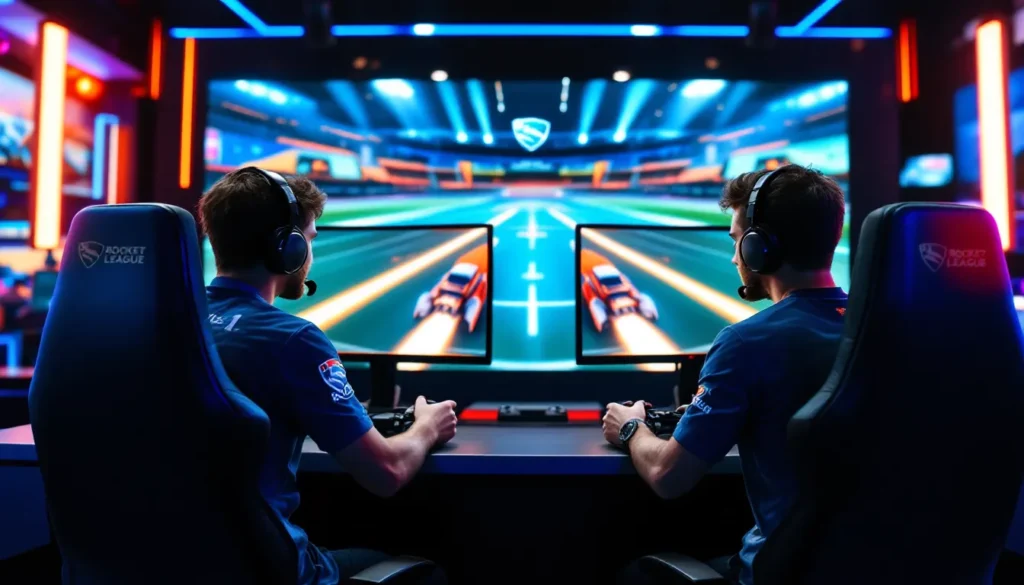
If you’ve played Rocket League for more than a few hours, you’ve probably experienced it: two cars lock bumpers, boost firing, neither willing to back down. You’re stuck in a deadlock while your teammates scramble in a 2v2 situation. This isn’t a glitch or accident, it’s Rule 1, and breaking it is considered one of the most dishonorable things you can do in the game.
Rule 1 isn’t written in any official rulebook. Psyonix never coded it into the game, and you won’t find it in patch notes or tutorials. Yet it’s one of the most universally recognized and respected traditions in Rocket League’s community. Veterans uphold it religiously, and new players quickly learn that when you’re locked with an opponent, you don’t disengage, ever. Not until the game breaks you apart.
Understanding Rule 1 goes beyond just knowing what it is. It’s about respecting the culture, knowing when and how it applies, and recognizing the strategic and comedic chaos it brings to matches. Whether you’re grinding ranked in Season 13 or playing casual 3v3s, Rule 1 remains as relevant in 2026 as it was when the community first adopted it years ago.
Key Takeaways
- Rule 1 is an unwritten Rocket League tradition where two locked cars must hold boost and remain connected until an external force separates them, with breaking the lock considered deeply dishonorable regardless of competitive stakes.
- The honor code behind Rule 1 applies universally across all game modes and ranks, enforced entirely through community social pressure rather than in-game penalties.
- Rule 1 originated organically in early Rocket League (2015-2016) and was popularized by streamers and content creators, becoming standardized as ‘Rule 1’ by 2017-2018 and remaining a rite of passage for new players.
- While Rule 1 creates a strategic disadvantage by removing a player from active gameplay, the community consensus is that honoring the tradition matters more than winning, even in ranked matches.
- Multi-car Rule 1 locks and wall/corner variations are rarer but considered even more sacred, with the longest recorded locks in casual matches lasting over a minute.
- Professional players generally honor Rule 1 in casual and scrimmage settings but may break it in high-stakes tournament matches where financial or career implications are significant.
What Is Rule 1 in Rocket League?
Rule 1 is the unwritten law that when two cars become locked head-to-head or bumper-to-bumper, both players must hold down boost and remain locked until an external force separates them. No reversing. No dodging out. No breaking the lock intentionally.
The rule is simple: once you’re in, you’re committed. Your team might be down a goal with 30 seconds left, but if you’re locked with an opponent, honor dictates you stay locked. Breaking Rule 1 is seen as a betrayal of the community’s code, often resulting in chat spam, teammate frustration, or even good-natured roasting from the opponent.
The Core Mechanics of Rule 1
Rule 1 occurs when two cars collide front-to-front or at an angle where their momentum cancels out, creating a stalemate. Both players hold boost continuously, which keeps the cars pressed together. The lock can happen anywhere on the field, midfield, in the corner, even on the walls.
The physics of Rocket League mean that as long as both players maintain forward momentum with boost, the cars will stay pinned. The moment one player stops boosting or reverses, the lock breaks. This creates a test of commitment: will you hold your ground, or will you be the one to dishonor the tradition?
In most cases, the lock will only break when:
- A third player demolishes one of the locked cars
- A fourth player bumps one or both cars out of the lock
- The ball hits one of the locked cars with enough force
- The cars drift into a wall or obstacle that separates them naturally
When Does Rule 1 Apply?
Rule 1 applies any time two cars are locked head-to-head, regardless of game mode, rank, or score. It doesn’t matter if you’re in a casual match, a Diamond tournament, or an RLCS qualifier, the rule is the rule.
That said, the lock must be legitimate. A quick bump or glancing collision doesn’t count. The lock needs to be sustained and mutual, with both players clearly stuck in a standoff. If one car is clearly pushing the other backward, that’s not a Rule 1, that’s just a bump.
Some players debate whether Rule 1 applies in private matches or when playing with friends, but the community consensus is clear: Rule 1 is universal. Even pros in tournament settings have honored it, much to the delight (or frustration) of their teammates.
The Origins and History of Rule 1
The exact origin of Rule 1 is murky, like most internet traditions. It likely emerged organically in the early days of Rocket League’s release in 2015, when players noticed the physics quirk that allowed two cars to lock indefinitely. Instead of treating it as a nuisance, the community turned it into a ritual.
Early forum posts and Reddit threads from 2015-2016 show players discussing the “unwritten rule” of staying locked. It wasn’t called “Rule 1” initially, some called it the “nose-to-nose rule” or the “lock law.” The term “Rule 1” became standardized around 2017-2018 as Rocket League’s competitive scene grew and the community meme culture solidified.
Interestingly, there was a brief period where some players tried to designate “don’t steal your teammate’s boost at kickoff” as Rule 1, but that never stuck. The lock rule won out, and by 2018, it was universally accepted as the Rule 1.
How the Community Adopted Rule 1
Rule 1’s adoption was driven by streamers, content creators, and the Reddit community. Players like Jon Sandman and SunlessKhan showcased Rule 1 moments in their videos, often with comedic commentary as teammates scrambled in a 2v2 situation. These clips went viral, spreading the tradition to new players.
The honor system behind Rule 1 resonated with players because it added a layer of respect and humor to matches. It became a way to acknowledge your opponent as a fellow player who understands the culture. Breaking Rule 1 was seen as disrespectful, not because it hurt your chances of winning, but because it showed you didn’t respect the community’s traditions.
By 2019, Rule 1 was so ingrained that even professional players in RLCS matches would occasionally honor it, leading to hilarious moments where casters and analysts had to explain the tradition to new viewers.
Evolution of Rule 1 Over the Years
As Rocket League evolved through updates, seasons, and the free-to-play transition in 2020, Rule 1 remained constant. New mechanics like air dribbles, flip resets, and ceiling shots came and went from the meta, but Rule 1 endured.
In 2021, Psyonix even acknowledged the tradition indirectly by including Rule 1 references in community events and social media posts. While they never officially endorsed it, the developers clearly understood its cultural significance.
By 2026, Rule 1 has become a rite of passage for new players. If you’re grinding through Bronze or Silver, you’ll encounter it. If you’re pushing for SSL, you’ll still see it. Some players have reported Rule 1 locks lasting over a minute in casual matches, with teammates either trying to break the lock or protecting it by demo-ing anyone who gets close.
Why Rule 1 Matters in Rocket League Culture
Rule 1 isn’t just a meme, it’s a symbol of the community’s ability to create and enforce its own norms. In a competitive game where every second matters, choosing to honor Rule 1 is an act of shared culture. It shows that sometimes, the unwritten rules matter more than the win.
This tradition also highlights the unique blend of competition and camaraderie in Rocket League. You’re trying to score on your opponent, but you’re also part of the same community. Rule 1 is a moment where that duality is on full display.
The Honor Code Behind Rule 1
The honor code is simple: you don’t break Rule 1. If you’re locked, you stay locked. Even if your team is losing. Even if the ball is rolling into your open net. Even if you have a perfect opportunity to score.
This code is enforced entirely through social pressure. There’s no in-game penalty for breaking Rule 1, but the community will let you know. Expect “Rule 1.” spam in chat, sarcastic “Wow.” quick chats, or even your own teammates calling you out.
The honor code extends to teammates as well. If your teammate is locked in Rule 1, you’re expected to play the rest of the match down a player. Some teammates will even protect the Rule 1 lock by demo-ing opponents who try to break it up, adding another layer of chaos to the situation.
Many players on forums and communities like ProSettings have shared stories about honoring Rule 1 in ranked matches, even when it cost them the game. The consensus? It was worth it.
Community Reactions to Breaking Rule 1
Breaking Rule 1 is one of the fastest ways to earn the scorn of the Rocket League community. If you intentionally disengage from a lock, expect immediate backlash. Opponents will call you out, teammates might throw the match in protest, and if you’re streaming, your chat will roast you.
Reddit threads are full of clips showing players breaking Rule 1, often titled “This player has no honor” or “Rule 1 breaker gets instant karma.” In many of these clips, the player who broke the rule ends up on the losing end of the match, which the community treats as cosmic justice.
That said, the community is generally forgiving of accidental breaks. If you run out of boost and drift out of the lock, or if a teammate bumps you without realizing, most players understand. It’s the intentional, shameless breaks that earn the real hate.
Some players embrace the villain role and break Rule 1 just to troll, but they’re in the minority. The vast majority of the community, from casual players to SSL grinders, respects the tradition.
How to Properly Execute Rule 1
Executing Rule 1 correctly is straightforward, but there are nuances. If you’re new to the tradition, here’s how to do it right.
Step-by-Step Guide to Locking In
-
Recognize the Lock: When you collide head-to-head with an opponent and both cars come to a standstill, you’re in a potential Rule 1 situation. Check if you’re both stuck and unable to move forward without mutual boost.
-
Hold Boost (Default: Shift on PC, R2/RT on controllers): Immediately hold down your boost button. This keeps your car pressed against your opponent’s. Don’t let go, even if your boost meter hits zero, holding the button is what matters for maintaining forward pressure.
-
Don’t Dodge or Reverse: Resist the urge to dodge out or reverse. Even if the ball is heading toward your goal, you’re committed now. Your teammates will have to handle it.
-
Stay Locked Until Separated: The lock ends when an external force breaks it, a demo, a bump from another player, or the ball hitting you. Don’t break it yourself.
-
Optional: Communicate in Chat: Some players like to acknowledge the Rule 1 in chat with a simple “Rule 1” or “o7” (a salute emote). This shows mutual respect and commitment.
What to Do While Locked in Rule 1
Once you’re locked, you’re basically a spectator with a job: hold boost. But there are a few things you can do to pass the time:
- Watch the Play: Use ball cam or free cam to follow the action. You’re still part of the team mentally, even if you can’t move.
- Communicate: If you’re in voice chat, call out plays for your teammates. “They’re rotating back post” or “Ball’s free mid” can help your team adapt to the 2v2 situation.
- Mind Games: Some players try to bait their opponent into breaking by letting off boost momentarily. This is risky and considered borderline dishonorable, but it happens.
- Enjoy the Moment: Rule 1 locks can be hilarious, especially if they last a long time. Embrace the absurdity.
If you’re playing on PC, you might notice your boost meter draining if you’re low on pads. In these cases, keep holding the boost button even when empty, forward acceleration still applies, keeping the lock intact.
Strategic Impact of Rule 1 on Gameplay
While Rule 1 is a cultural tradition, it has real strategic consequences. Losing a player to a Rule 1 lock turns a 3v3 into a 2v2, or a 2v2 into a 1v1. This shift can dramatically affect rotations, defensive coverage, and offensive pressure.
How Rule 1 Affects Team Dynamics
When one of your players is locked in Rule 1, your team has to adapt quickly. In 3v3, losing a player is manageable, your remaining two players can rotate more aggressively and cover for the missing third. In 2v2, but, a Rule 1 lock puts enormous pressure on your solo teammate.
Smart teams will:
- Adjust rotations: The remaining players need to cover more ground and avoid over-committing.
- Play more defensively: With one fewer player, risky plays become even riskier. Staying back and forcing the opponent to make mistakes is often the best strategy.
- Communicate: If you’re locked, keep calling out where the ball and opponents are. Your eyes are still useful.
In high-level play, a Rule 1 lock can be a strategic advantage or disadvantage depending on who’s locked. If your third player (the defensive anchor) is locked, you’re in trouble. If your aggressive striker is locked, you might actually benefit from a slower, more methodical pace.
According to discussions on competitive gaming communities like Dot Esports, some teams have experimented with intentionally locking an opponent’s star player to neutralize their impact, though this is rare and difficult to execute.
Turning Rule 1 Situations to Your Advantage
Believe it or not, you can sometimes use Rule 1 to your advantage. Here’s how:
- Lock Their Best Player: If you recognize that the opponent’s carry is locked, your team can exploit the mismatch. Focus on attacking their weaker players.
- Protect the Lock: If your teammate is locked with an opponent, consider demo-ing anyone who tries to break it. This keeps the 2v2 situation stable and prevents a sudden 3v2 swing.
- Boost Starve: With one fewer player rotating, boost management becomes critical for the opponent. If you can control the mid boost pads, you’ll have a significant advantage.
- Patience: Don’t force plays just because you’re down a player. Wait for the opponent to make a mistake, then capitalize.
That said, trying to intentionally create a Rule 1 lock is difficult and usually not worth the effort. The situations arise naturally, and when they do, you adapt.
Common Rule 1 Scenarios and Variations
Not all Rule 1 locks are created equal. Depending on where and how the lock happens, the situation can vary wildly.
Head-to-Head Locks
This is the classic Rule 1: two cars collide perfectly head-to-head, usually in midfield or along the side wall. Both players hold boost, and the cars remain stationary or drift slowly in one direction.
Head-to-head locks are the most common and the easiest to maintain. They usually last until a teammate or the ball breaks them up. These locks are also the most respected, there’s no ambiguity about whether it’s a legitimate Rule 1.
Multi-Car Rule 1 Situations
Occasionally, you’ll see a three-car or even four-car Rule 1. This happens when additional players collide into an existing lock, creating a chaotic pile of cars all holding boost.
Multi-car Rule 1s are rare but legendary. When they happen, it’s usually in casual matches where players are more willing to embrace the chaos. In competitive play, teammates will often demo the pile to free their player and regain the numbers advantage.
The community treats multi-car Rule 1s as even more sacred than standard locks. Breaking one is considered especially dishonorable.
Wall and Corner Rule 1 Locks
Rule 1 can also happen on walls or in corners, where the physics get even weirder. Wall locks often involve cars pinned at awkward angles, sometimes with one or both cars defying gravity.
Corner locks are particularly frustrating because they tend to last longer, the confined space makes it harder for teammates or the ball to break the lock. If you’re stuck in a corner Rule 1, settle in. You might be there a while.
One quirk of wall locks: if one player stops boosting, both cars might fall off the wall together, which technically counts as an external force breaking the lock. Most players agree this is an acceptable way for the lock to end.
When Is It Acceptable to Break Rule 1?
The community is mostly united: you don’t break Rule 1. But there are edge cases and ongoing debates about when (if ever) breaking the lock is acceptable.
Accidental Breaks vs. Intentional Breaks
Accidental breaks are generally forgiven. If you run out of boost and drift out of the lock, or if a teammate bumps you without realizing what’s happening, most players won’t hold it against you.
Intentional breaks, but, are a different story. If you deliberately reverse or dodge out of a Rule 1 to rejoin the play, you’re violating the code. The community will let you know.
Some players argue that if your teammate accidentally breaks the lock by bumping you, you’re free to go. Others say you should try to re-establish the lock if possible. There’s no official ruling, but the general consensus leans toward the latter.
Competitive vs. Casual Play Considerations
This is where the debate gets spicy. Some players believe that in competitive ranked matches, especially at high ranks like Champion, Grand Champion, or SSL, breaking Rule 1 is acceptable if the match is on the line.
The argument goes: ranked is for trying to win, and honoring Rule 1 when you’re down a goal with 20 seconds left is throwing the game. These players see Rule 1 as a casual tradition that shouldn’t override competitive integrity.
The counterargument, held by the majority of the community, is that Rule 1 applies everywhere. Rank doesn’t matter. Score doesn’t matter. The rule is the rule. Breaking it, even in ranked, is dishonorable.
Content platforms like Game8 have covered this debate in community polls, and the results consistently favor universal Rule 1 enforcement, even in competitive settings. That said, individual players will always have their own code.
In professional tournament play, the question becomes even murkier. Most pros will honor Rule 1 in casual or scrimmage settings but might break it in a live RLCS match where thousands of dollars are on the line. The community generally gives pros a pass in these high-stakes situations, though the memes will fly regardless.
Rule 1 in Professional and Esports Play
Pro players are just as bound by Rule 1 as the rest of us, at least in theory. In reality, the decision to honor or break Rule 1 in a professional setting depends on context, stakes, and individual player philosophy.
Notable Pro Player Rule 1 Moments
There have been several memorable Rule 1 moments in RLCS history. One of the most famous occurred during a regional qualifier in 2021, when two players locked in a corner for nearly 40 seconds while their teams battled 2v2. The casters were in disbelief, and the clip went viral on Reddit and Twitter.
Another notable moment involved GarrettG of NRG Esports, who honored a Rule 1 lock during a scrimmage match, even as his teammates scrambled to defend. The moment was widely praised by the community as an example of a pro respecting the culture.
That said, there have also been instances of pros breaking Rule 1 in tournament matches, usually when the score is close or the timer is low. These breaks are often met with boos from the live audience and memes from the online community, though most fans understand the competitive pressure.
How Pros Handle Rule 1 in Tournaments
In high-stakes tournament matches, most pros will break Rule 1 if it means the difference between advancing or being eliminated. The financial and career implications are too significant to risk for the sake of tradition.
But, in lower-stakes matches, early group stages, showmatches, or content creator tournaments, pros are more likely to honor Rule 1. It’s a way to connect with the community and show they’re not taking themselves too seriously.
Some pros have openly stated their stance on Rule 1. Squishy Muffinz has said in streams that he’ll honor Rule 1 in ranked but not in tournaments. jstn has joked that he’ll honor it “until it costs us the series.” These mixed approaches reflect the broader community debate about when, if ever, breaking Rule 1 is acceptable.
Coaches and analysts have also weighed in, with some suggesting that getting locked in Rule 1 during a critical moment is a mental mistake that should be avoided in the first place. Others argue that once you’re locked, you’re locked, honor demands you stay.
Conclusion
Rule 1 is more than just a quirky tradition, it’s a cornerstone of Rocket League’s community identity. It’s the moment where competition pauses, where honor overrides strategy, and where players from Bronze to pro level share a common code.
Whether you’re grinding through Season 13 ranked matches or just messing around in casual, you’ll encounter Rule 1 eventually. When you do, you’ll have a choice: honor the lock and earn the respect of your peers, or break it and risk the wrath of the community. Most players choose honor, and that’s what makes Rocket League’s culture special.
As the game continues to evolve in 2026 and beyond, Rule 1 will remain. New mechanics will come and go, metas will shift, and seasons will pass, but the sacred lock endures. So next time you find yourself bumper-to-bumper with an opponent, hold that boost. Stay committed. And whatever you do, don’t break Rule 1.
More Stories
Rocket League Camera Settings: The Ultimate 2026 Guide to Perfect Your View
The Coolest Rocket League Cars: Ultimate Style Guide for 2026
Justin Rocket League: The Rise of a Freestyle Legend and His Impact on Competitive Play