
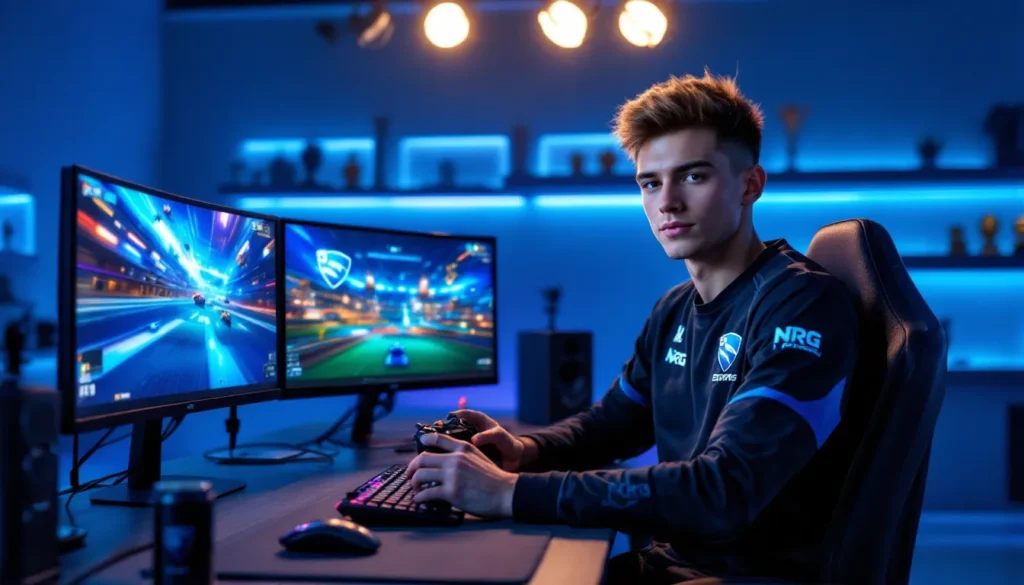
Few players in Rocket League history have delivered a moment so iconic it becomes their calling card. For Justin “JSTN” Morales, that moment came in a split-second zero-goal that turned the RLCS World Championship on its head and announced him as one of the most mechanically gifted players to ever touch the game. Since then, JSTN has evolved from a teenage prodigy into a cornerstone of competitive Rocket League, consistently pushing the boundaries of what’s possible with aerial control, flip resets, and in-game IQ. His influence reaches beyond tournament wins, his camera settings are studied, his training routines replicated, and his playstyle dissected by players at every rank. Whether you’re chasing Grand Champion or just want to understand what separates the pros from everyone else, JSTN’s career offers a masterclass in mechanical excellence and clutch performance.
Key Takeaways
- JSTN’s iconic zero-second goal at the RLCS Season 5 World Championship became Rocket League’s most unforgettable moment, validating advanced mechanics like flip resets and ceiling shots as legitimate competitive tools rather than just freestyle tricks.
- JSTN’s mechanical excellence combines unpredictable aerial dominance, functional flip resets, and elite game sense—qualities that have made him a franchise-level player across multiple seasons and meta shifts.
- His camera settings (110 FOV, 270 distance, 0.45 stiffness) and tight controller deadzone (0.05) are widely replicated by players seeking to improve precision on dribbles and aerial adjustments.
- JSTN’s consistent practice approach emphasizes repetition in training packs, ring maps, and free-play aerial control over attempting flashy high-difficulty mechanics without foundation.
- His ability to balance aggression with patience—making plays on low boost, understanding rotation holes, and avoiding over-commitment—separates him from mechanically gifted players who crack under tournament pressure.
- JSTN’s sustained success across years of competitive evolution demonstrates that mastering fundamentals before breaking the rules is the true path to elite-level Rocket League performance.
Who Is JSTN? The Prodigy Who Redefined Rocket League
Early Career and Breakthrough Moments
JSTN entered the competitive Rocket League scene in 2017 when he was just 14 years old, joining NRG Esports alongside veterans GarrettG and Fireburner. Most rookies spend their first season learning the ropes, but JSTN arrived with mechanics that looked like they’d been borrowed from the future. His aerial reads were instant, his recoveries impossibly fast, and his decision-making under pressure showed a composure that belied his age.
What set JSTN apart early wasn’t just raw talent, it was how quickly he adapted to RLCS-level speed and physicality. By RLCS Season 5, he’d already become NRG’s primary offensive engine, taking over possessions that looked dead and converting them into scoring chances. The synergy between his freestyle approach and GarrettG’s consistency created a dynamic that would define NRG’s identity for years.
The Iconic Zero-Second Goal That Shook the RLCS
On June 10, 2018, during the RLCS Season 5 World Championship Grand Finals, JSTN cemented his legacy with one of the greatest goals in esports history. With NRG down 2-3 in the series and trailing by one goal, the clock hit zero. Dignitas began celebrating. Then JSTN, positioned perfectly at midfield, launched into the air, met a floating ball with a perfectly timed flip, and buried it into the net as the timer read 0:00.
The arena erupted. The series went to overtime. NRG won the game, forced a bracket reset, and claimed the world championship. That goal didn’t just win a series, it became the blueprint for why you never quit until the final whistle. The clip has been replayed millions of times, and it’s still referenced whenever someone talks about clutch plays in Rocket League. JSTN was 15 years old.
JSTN’s Playstyle: What Makes Him a Mechanical Monster
Offensive Creativity and Aerial Dominance
JSTN’s offensive game revolves around unpredictability. Where most pros rely on practiced setups and team passing plays, JSTN thrives in chaos, 50/50 challenges that ricochet into awkward spots, balls floating near the ceiling, and tight angles that force defenders to guess. His aerial dominance comes from two things: reaction speed and touch variety. He doesn’t just go up for aerials: he adjusts mid-flight, changes his flip timing, and places the ball where defenders aren’t expecting it.
What makes his playstyle so effective is how naturally he transitions between offense and defense. One moment he’s demo-chaining the backline, the next he’s rotating back for a critical save. Many professional teams following competitive gaming coverage have studied how JSTN’s offensive pressure creates openings that wouldn’t exist with more conservative play.
Flip Resets, Air Dribbles, and Advanced Mechanics
JSTN’s mechanical toolkit reads like a freestyle montage: flip resets, ceiling shots, air dribbles, double taps, and everything in between. But unlike flashy freestylers who go for clips, JSTN uses these mechanics as functional tools. His flip resets aren’t for style, they’re for creating unpredictable angles that force defenders to commit or concede space.
His air dribble control is particularly lethal. Instead of carrying the ball in a straight line, he constantly adjusts speed and trajectory, making it nearly impossible for goalies to read his final touch. That ability to delay and manipulate defenders has made him one of the most dangerous 1v1 threats in competitive play, even in a 3v3 format.
Positioning and Game Sense Beyond the Flashy Plays
It’s easy to focus on JSTN’s mechanics and miss the game sense underneath. His positioning is elite, he reads rotation holes, knows when to challenge aggressively, and understands when to sit back and let teammates apply pressure. His boost management is clean: he rarely finds himself stranded without options, and he’s comfortable making plays on low boost that would panic most players.
JSTN’s decision-making in high-pressure situations separates him from mechanically gifted players who crack under tournament stakes. He doesn’t force plays. When his team needs a goal, he finds it. When they need time, he burns clock. That balance between aggression and patience is why he’s remained a top-tier player across multiple seasons and meta shifts.
Career Highlights and Championship Wins
RLCS Season 5 World Championship Victory
JSTN’s crowning achievement remains the RLCS Season 5 World Championship in June 2018. That tournament run wasn’t just about the zero-second goal, it was a statement series. NRG entered as underdogs against Dignitas, the reigning champions and heavy favorites. After the iconic overtime goal forced a bracket reset, NRG dominated the second best-of-seven series 4-1, claiming their first world title.
That championship validated everything NRG had built. JSTN was named RLCS Season 5 World Championship MVP, a fitting recognition for a player who’d been the difference-maker in nearly every crucial game. The victory also marked a shift in the competitive landscape, mechanical brilliance had beaten out veteran consistency, and the next generation of Rocket League had officially arrived.
Other Major Tournament Successes and Roster Changes
Beyond the Season 5 title, JSTN has stacked up an impressive trophy case. He won RLCS Season X North American Major in 2021 and claimed multiple DreamHack and regional championships throughout his career. After years with the original NRG roster, the team eventually added Squishy Muffinz in place of Fireburner, creating one of the most mechanically stacked lineups in RLCS history.
That roster change brought new dynamics. Squishy’s freestyle-heavy approach paired with JSTN’s unpredictability made NRG a nightmare to defend, though it sometimes led to over-rotation issues. In later seasons, NRG cycled through additional roster changes, adding players like SquishyMuffinz and experimenting with different third-man rotations. JSTN remained the constant, the franchise player who adapted to each new teammate and kept NRG competitive at the highest level.
His consistency across multiple years, patches, and meta shifts speaks to his ability to evolve. While some pros fade as the game changes, JSTN has continued refining his mechanics and adapting his playstyle to whatever the current meta demands.
JSTN’s Camera Settings, Controls, and Setup
Camera Configuration Breakdown
JSTN’s camera settings have been analyzed and copied by thousands of players trying to replicate his visual setup. Here’s his configuration as documented across pro player settings databases:
- Field of View (FOV): 110
- Distance: 270
- Height: 110
- Angle: -3.0
- Stiffness: 0.45
- Swivel Speed: 4.70
- Transition Speed: 1.20
These settings favor a slightly closer camera distance compared to some pros, giving JSTN better precision on dribbles and aerial adjustments. The 110 FOV is the maximum and standard among top-level players, providing the widest possible view of the field. His -3.0 angle keeps the camera low enough to see the ball during ground plays but not so aggressive that aerials become awkward.
The 0.45 stiffness is on the looser side, allowing the camera to drift slightly during sharp turns. This can feel disorienting for newer players but gives advanced players more natural feedback during recoveries and wave dashes.
Controller Bindings and Deadzone Settings
JSTN plays on a standard PlayStation controller and uses bindings that prioritize aerial control and fast inputs:
- Boost: R1 (right bumper)
- Jump: X (default)
- Air Roll Left/Right: L1 (left bumper) and Square
- Powerslide: L1 (same bind as air roll)
- Ball Cam Toggle: Triangle
His deadzone settings are relatively tight:
- Controller Deadzone: 0.05
- Dodge Deadzone: 0.50
- Aerial Sensitivity: 1.40
- Steering Sensitivity: 1.30
The low controller deadzone gives him instant stick response, which is critical for micro-adjustments during flip resets and air dribbles. His aerial sensitivity at 1.40 is slightly above average, allowing for faster air roll adjustments without sacrificing control. Most players experimenting with JSTN’s settings find the low deadzone takes time to adjust to, any stick drift becomes noticeable, and inputs feel hyper-responsive.
Learning from JSTN: Tips to Improve Your Rocket League Game
Mastering Aerial Control and Flip Resets
If you want to emulate JSTN’s aerial dominance, start with aerial car control in free play. Spend 10-15 minutes per session flying around the map without touching the ground, focusing on smooth air roll adjustments and maintaining control at different speeds. The goal isn’t to go fast, it’s to be comfortable in the air at any angle.
Flip resets are JSTN’s signature, but they’re not beginner-friendly. Before attempting resets, master basic air dribbles from the wall and ceiling shots. Once you can carry the ball consistently, practice getting all four wheels to touch the ball mid-air. Start with slow setups off the wall where you can take your time. As you get comfortable, increase speed and incorporate directional air rolls for unpredictable angles.
Training Packs and Practice Routines
JSTN didn’t build his mechanics overnight. He’s logged thousands of hours in training packs, and you should too. Here are the types of packs that build the skills JSTN relies on:
- Aerial redirects: Improves reaction time and mid-air adjustments
- Ceiling shots: Builds comfort with upside-down car control
- Wall-to-air dribbles: Teaches ball carry and touch control
- Flip reset setups: Specific packs that feed you reset opportunities
Consistency matters more than difficulty. Running the same pack until you hit 8/10 shots builds muscle memory far better than jumping between packs randomly. JSTN’s practice approach emphasizes repetition, he’ll grind the same mechanic for hours until it’s automatic.
Incorporate ring maps (available on Steam Workshop for PC players) to sharpen aerial precision. These maps force tight, controlled flight paths and dramatically improve car control over time.
Decision-Making and Boost Management Like a Pro
Mechanics get the highlights, but JSTN’s game sense is what keeps him effective. One of the biggest gaps between ranked players and pros is decision-making speed. JSTN processes defensive rotations, boost positions, and opponent tendencies in real time, making split-second calls that look instinctive.
To improve decision-making, watch your own replays from the opponent’s perspective. You’ll see where you over-committed, missed rotations, or wasted boost on unnecessary challenges. Focus on boost efficiency, JSTN regularly makes plays on 20-30 boost because he prioritizes positioning over topping off.
Another key habit: intentional challenges. JSTN doesn’t challenge just because the ball is near him. He challenges when it disrupts the opponent’s play or creates an advantageous 50/50. Practice identifying when not to challenge, and you’ll find yourself out of position far less often.
JSTN’s Impact on the Rocket League Community and Meta
JSTN’s influence extends beyond tournament wins, he fundamentally shifted how the community views mechanics. Before JSTN, flip resets and ceiling shots were considered risky, low-percentage plays. His consistent success with those mechanics in high-stakes matches proved they weren’t just freestyle tricks: they were legitimate competitive tools.
That validation opened the floodgates. Ranked players at every level started incorporating advanced mechanics into their games, and the overall skill ceiling of the player base rose dramatically. What was once SSL-exclusive tech started appearing in Champion and even Diamond lobbies. JSTN didn’t just perform mechanics, he normalized them.
His zero-second goal became Rocket League’s most iconic moment, referenced constantly across esports coverage platforms and used in highlight reels to showcase the game’s potential for drama. That single play has probably converted more casual viewers into Rocket League fans than any other moment in the game’s history.
On the content side, JSTN’s highlights and gameplay have been dissected in thousands of YouTube tutorials, coaching sessions, and Reddit threads. His camera settings and controls are some of the most commonly copied in the community. Players trust that if it works for JSTN, it’s worth trying.
His impact also pushed the meta toward mechanical variance. Teams realized that having at least one player who could create from nothing, like JSTN, was invaluable when structured plays broke down. That shift influenced roster construction across all regions, with teams prioritizing mechanical ceiling alongside consistency and team play.
Where Is JSTN in 2026? Current Team and Future Prospects
As of March 2026, JSTN remains one of the most closely watched players in the Rocket League esports scene. After his long tenure with NRG, he’s navigated roster changes and shifts in the competitive landscape, adapting his game to new teammates and evolving strategies. While specific 2026 roster details fluctuate during the competitive season, JSTN’s reputation as a franchise-level talent means he’s consistently in demand.
The competitive meta in 2026 has continued to emphasize speed, demos, and mechanical unpredictability, all areas where JSTN excels. His ability to stay relevant across multiple years and patches speaks to his work ethic and adaptability. Where some pros peak early and fade, JSTN has shown he can reinvent his playstyle as the game evolves.
Looking forward, JSTN’s legacy is already secure. He’s a world champion, an MVP, and the author of Rocket League’s most unforgettable moment. Whether he adds more titles or transitions into content creation, coaching, or other roles in the scene, his influence on the game is permanent. For now, he’s still grinding ranked, still hitting flip resets, and still proving that the kid who shocked the world in 2018 has plenty left in the tank.
Conclusion
JSTN’s career is a reminder that Rocket League rewards both brilliance and resilience. His zero-second goal will live forever, but it’s his sustained excellence across years of competition that defines him. From his early breakout as a 14-year-old prodigy to his evolution into a veteran leader, JSTN has consistently pushed the boundaries of what’s mechanically possible while maintaining the game sense and composure needed to win championships. His camera settings, controls, and training routines offer a blueprint for improvement, but his real lesson is simpler: master the fundamentals, then break the rules. Whether you’re chasing SSL or just trying to hit your first flip reset, studying JSTN’s approach, both the flashy highlights and the quiet consistency, will make you a better player.
More Stories
Rocket League Camera Settings: The Ultimate 2026 Guide to Perfect Your View
The Coolest Rocket League Cars: Ultimate Style Guide for 2026
Justin Rocket League: The Rise of a Freestyle Legend and His Impact on Competitive Play